
Why Printed Shirts Peel, Crack or Fade
A damaged print almost always traces back to one of two things: a production problem (the ink, the heat and time used to press or cure it, or the wrong technique for the fabric) or how the shirt was washed, ironed and dried afterwards. The fastest way to tell them apart is to look at how it failed and when: a print that peels or cracks after one or two washes is usually a production fault; a print that fades evenly over months of wear is normal wear or a care problem.
This guide helps you read the symptoms on a shirt you already have, know what to ask your supplier, and prevent it at the ordering stage — rather than hunting for home repair tricks.
Read the failure to find the cause
Each printing technique fails in its own way, because the ink sits on the shirt differently: DTG soaks into the fibers, while DTF, heat transfer and vinyl are a layer heat-pressed on top of the fabric. The most common symptoms:
| Symptom | Typical technique | Common technical cause | Usually down to |
|---|---|---|---|
| Peeling in patches, edges lifting | Vinyl, heat transfer, DTF | Pressed with too little heat, time or pressure so the adhesive never bonded; or ironed directly / tumble-dried hot | The printer if it peels within the first few washes; the wearer if it was ironed or dried hot |
| Fine cracking across the ink | Plastisol screen print, heat transfer, large DTF areas | A thick ink layer on stretchy fabric, ink not fully cured; heavy stretching, hot drying | Either |
| Print washes out after the first wash | DTG | Ink not properly heat-cured, or DTG printed on high-polyester fabric | The printer |
| Even fading over time | DTG, water-based screen print | Hot washes, bleach, long exposure to strong sun | Usually care; unusually fast fading is worth raising with the printer |
| White print turning pink or grey on colored polyester | Screen print, DTF, heat transfer on poly | Dye migration — the polyester’s dye sublimates into the ink under heat | The printer (ink or temperature not suited to poly) |
| Shiny, scorched fabric or a press-frame mark around the print | Any heat-pressed technique | Too much heat or pressure | The printer |
How each technique fails
DTG: it fades, it doesn’t peel
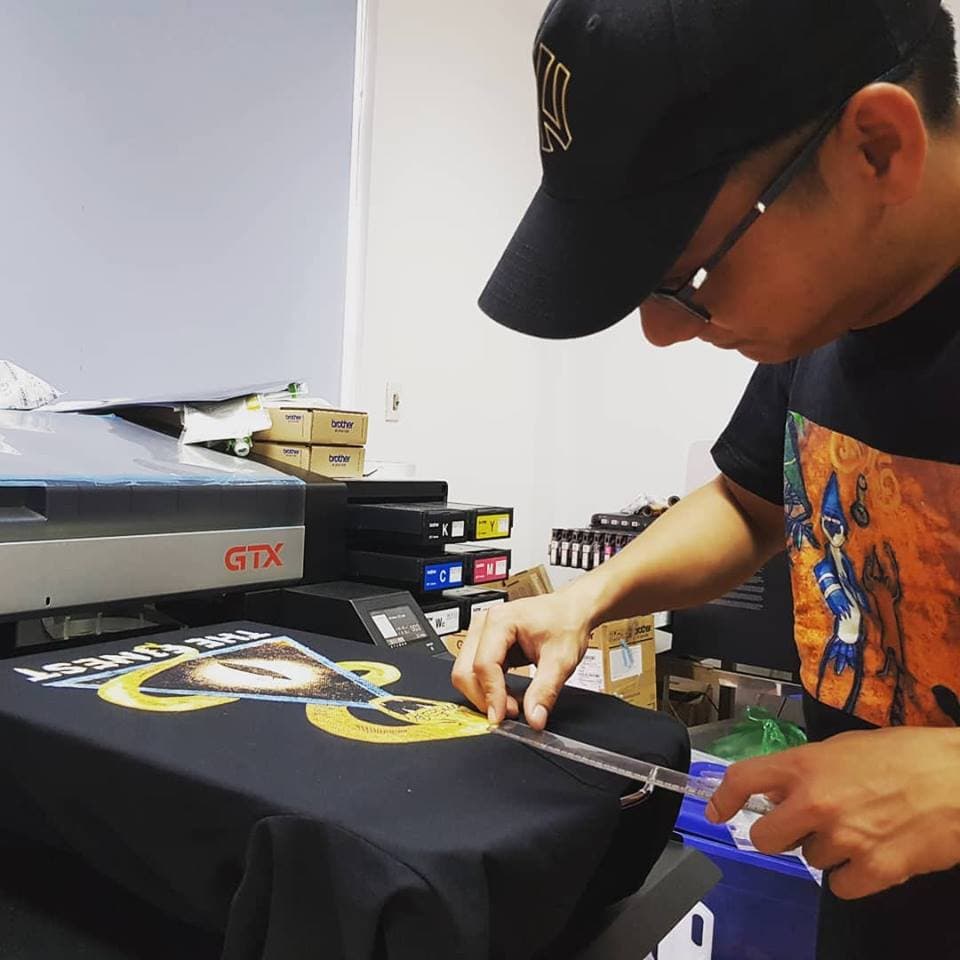
Water-based DTG ink is jetted into the cotton fibers rather than forming a film on top, so a DTG print almost never peels in patches. Its typical failure is gradual fading from hot washes, bleach or hot drying — see how to wash DTG-printed shirts. If a DTG print looks washed out right after the first wash, the usual causes are insufficient curing or DTG printed on a high-polyester blend, which DTG doesn’t color accurately anyway (see 100% cotton vs CVC/TC blends).
DTF and heat transfer: edges lift if under-pressed
DTF and heat transfer both print onto an intermediate film or paper and then heat-press it onto the shirt, so the print is a layer sitting on the fabric. Adhesion depends almost entirely on pressing at the right temperature, time and pressure. Under-pressed, the edges lift after a few washes; over-pressed, the surrounding fabric turns shiny or shows the press frame. Very large film areas also stiffen the print and crack when the shirt stretches — details in DTF printing and heat transfer.
Screen printing: cracks if the ink is thick or under-cured
Screen printing pushes a relatively thick layer of ink through a mesh. That layer is durable and vivid when the ink suits the fabric and is fully cured; under-cured ink, or a heavy ink layer on very stretchy fabric, tends to develop fine cracks over time. On colored polyester, light screen-print inks can also discolor as the fabric’s dye migrates under heat — which is why poly garments need a dedicated low-bleed ink. See screen printing.
Vinyl: the edges go first when ironed
Heat transfer vinyl is cut to shape and pressed on, so its weak point is the outline. Ironing directly on vinyl or drying it hot softens the adhesive and the edges start to lift; large vinyl areas also make that part of the shirt stiffer. Material quality matters a lot for adhesion — see heat transfer vinyl.
Printer’s fault or the wash? Three questions
- After how many washes did it fail? Peeling, cracking or a washed-out print within the first few washes points to production. Even fading over months is normal wear for any print.
- Did many shirts fail, or just a few? If many shirts from the same batch fail the same way even though everyone washes differently, it’s almost certainly a process problem (ink, heat, press time). If only a couple failed, look at how those were washed.
- How was it washed, ironed and dried? Hot water, bleach, high-heat tumble drying, ironing on the print and long strong-sun drying damage prints of every technique.
If you suspect a production fault: photograph the damage clearly, note how many times it was washed, keep the shirt as is and contact the supplier as early as possible within the warranty period. Don’t try to repair it first — that makes the cause much harder to confirm.
Can a damaged print be saved?
Only partly. Vinyl or DTF lifting slightly at the edges can be re-pressed with an iron over baking paper, but it’s a temporary fix and can leave the surrounding fabric shiny. A cracked or faded print can’t be restored to new. For a uniform order that failed across the batch, the right route is a warranty claim with the supplier, not re-gluing each shirt yourself.
Checklist before you order
- Pick the technique that suits the fabric and the design from the start — see DTG vs screen print vs heat transfer vs vinyl.
- Ask which ink the printer uses and what it’s certified for — the certificate belongs to the ink, not the whole factory (see OEKO-TEX certified ink).
- Ask for a sample and wash-test it a few times yourself before confirming a large order — the cheapest durability test a buyer can run.
- Get the warranty length and what it covers written into the quote or contract.
- Avoid very large heat-pressed film areas on very stretchy fabric; for a large multi-color graphic on cotton, consider DTG.
- Ask for care instructions and pass them on to wearers — especially for class, team and staff shirts handed out to many people.
How Startee handles it
- Technique matched to fabric: a Brother GTX DTG printer for cotton; polyester-heavy fabrics move to screen printing, DTF or heat transfer to keep the color bonded.
- Innobella DTG ink certified OEKO-TEX® ECO PASSPORT; heat transfer vinyl imported from South Korea and the US.
- For uniform orders, Startee sews a free sample before bulk production so you can check fit, fabric and print first.
- Every item is inspected before delivery.
- Warranty of up to 12 months depending on the product tier (Premium 12 months, Medium 6 months, Basic 3 months) — see pricing.